How Childhood Experiences Can Show Up at Work: What Leaders Need to Understand About Stress, Feedback, and Communication
Our experiences growing up can influence how we respond to authority, manage expectations, receive feedback, and navigate workplace relationships. Understanding these patterns can help leaders build more supportive and productive teams.
Have you ever noticed that two employees can receive the same feedback but respond very differently?
One employee may immediately become defensive. Another may withdraw and stop contributing. Someone else may become anxious about making a mistake or seek reassurance before moving forward.
These differences aren't always about motivation, work ethic, or personality.
Sometimes, the way we learned to respond to authority, expectations, boundaries, and relationships earlier in life can influence how we function as adults.
This doesn't mean our childhood determines who we become. However, early experiences can contribute to patterns that influence how we respond to stress, communicate our needs, and navigate relationships.
For leaders, managers, and supervisors, understanding this connection offers an opportunity to look beyond employee behavior and consider what might be influencing it.
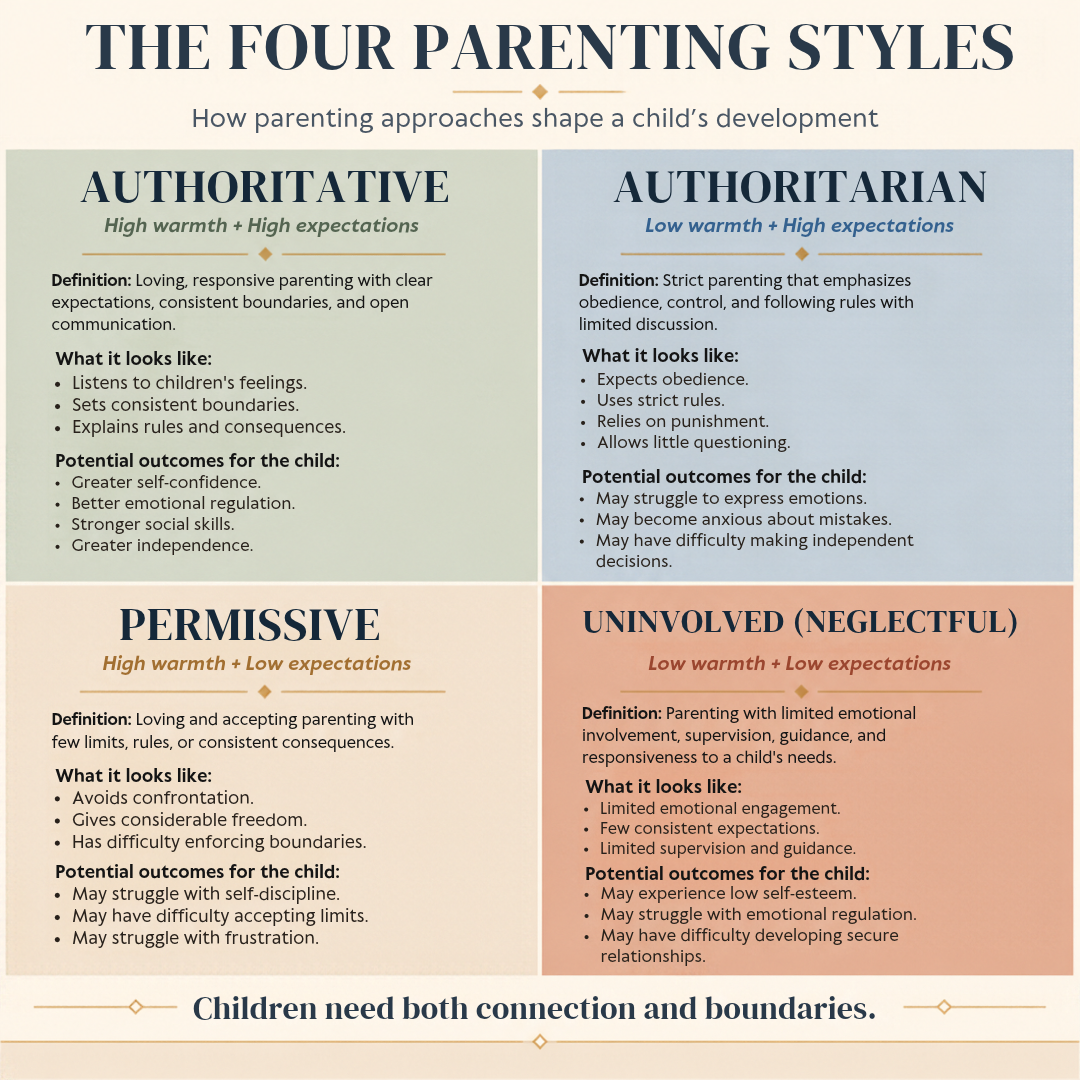
The Four Parenting Styles and How They May Show Up in the Workplace
Developmental psychologist Diana Baumrind identified three major parenting styles: authoritative, authoritarian, and permissive. Later research expanded the framework to include uninvolved parenting.
These styles are generally understood through two dimensions: warmth and responsiveness, and expectations and structure.
Although these categories describe parenting approaches, some of the patterns associated with them may offer insight into how adults navigate workplace relationships.
1. Authoritarian: "Just tell me what to do."
Authoritarian parenting emphasizes obedience, strict expectations, and discipline, often with limited room for discussion or individual perspectives.
How this might show up at work:
An employee who is accustomed to strict authority may:
Feel uncomfortable questioning a supervisor.
Worry excessively about making mistakes.
Seek approval before making decisions.
Interpret constructive feedback as criticism.
Avoid sharing concerns or disagreeing with leadership.
What leaders can do:
Create opportunities for employees to ask questions, share ideas, and express concerns without feeling that disagreement will result in negative consequences.
Explain the reasoning behind decisions and expectations. Encourage independent thinking rather than simply expecting compliance.
2. Permissive: "I don't like being told what to do."
Permissive parenting tends to emphasize warmth and acceptance while providing fewer consistent boundaries, rules, or consequences.
How this might show up at work:
An employee may:
Struggle with structure and accountability.
Become frustrated when expectations are enforced.
Have difficulty accepting feedback or limits.
Avoid uncomfortable conversations.
Struggle to prioritize responsibilities when there is little external structure.
What leaders can do:
Establish clear expectations and communicate responsibilities consistently.
Be supportive while maintaining accountability. Employees benefit from knowing what is expected, how success is measured, and what happens when commitments are not met.
Support and accountability are not opposites. Effective leadership requires both.
3. Uninvolved: "I'll figure it out myself."
Uninvolved parenting involves limited emotional responsiveness, guidance, supervision, and involvement in a child's life.
How this might show up at work:
An employee may:
Hesitate to ask for help.
Have difficulty trusting supervisors or colleagues.
Avoid sharing personal or professional challenges.
Feel disconnected from the team.
Struggle to communicate what they need to be successful.
What leaders can do:
Be intentional about checking in with employees rather than assuming silence means everything is fine.
Create consistent opportunities for communication. Follow through on commitments, provide guidance, and make it clear that asking for help is a normal part of working collaboratively.
4. Authoritative: "Let's work through this."
Authoritative parenting combines warmth, responsiveness, clear expectations, and consistent boundaries.
It encourages children to develop independence while knowing they have support and guidance.
How this might show up at work:
Adults who have experienced supportive relationships with appropriate boundaries may be more comfortable:
Receiving and giving constructive feedback.
Taking responsibility for their decisions.
Communicating needs and concerns.
Asking questions when something is unclear.
Navigating challenges with greater confidence.
What leaders can do:
Model the same balance of support and accountability.
Listen to employee perspectives, establish clear expectations, encourage problem-solving, and provide opportunities for people to take ownership of their work.
Importantly, these are possible patterns, not fixed outcomes. People can develop new ways of responding through experience, relationships, and intentional practice.
Why This Matters: The Connection Between Stress and Workplace Performance
When employees experience stress, their ability to concentrate, organize tasks, regulate emotions, and make decisions can be affected.
The brain and nervous system are constantly responding to the environment, including how we experience expectations, relationships, uncertainty, and perceived threats.
For example:
An employee who fears making mistakes may spend excessive time checking and rechecking their work.
Someone who feels uncomfortable asking questions may spend hours trying to solve a problem independently.
An employee who struggles with competing demands may become overwhelmed and jump between tasks without completing them.
Someone who interprets feedback as a personal threat may have difficulty focusing on the information being communicated.
These responses can affect more than individual performance. They can influence team communication, collaboration, productivity, and workplace relationships.
This is why understanding stress requires looking beyond what employees do and considering the conditions in which they are working.
Five Ways Leaders Can Create a More Supportive Workplace
Leaders don't need to know an employee's childhood history to create a supportive environment.
They do, however, need to be aware of how their own communication, expectations, and responses influence the people they supervise.
Here are five areas worth examining.
1. Practice listening before responding
When an employee brings you a concern, resist the urge to immediately explain, correct, or solve the problem.
Instead:
Give the person your full attention.
Avoid interrupting.
Ask open-ended questions.
Reflect back what you heard.
Clarify what support or information they need.
Try asking:
"What has been the most challenging part of this?"
"What would help you move forward?"
"What am I missing about this situation?"
Listening doesn't mean agreeing with everything. It means making an effort to understand before making a decision.
2. Examine how you respond to mistakes
Consider what happens when someone on your team makes a mistake.
Do you immediately express frustration? Do you ask questions? Do you use the situation as an opportunity to understand what happened?
Employees who anticipate criticism or embarrassment may become less likely to report problems, ask questions, or take appropriate risks.
Leaders can model accountability by addressing mistakes directly without humiliating the person involved.
Try asking:
"What contributed to this happening?"
"What can we learn from it?"
"What needs to change so we can prevent it in the future?"
3. Balance expectations with support
Employees need to understand what is expected of them.
However, expectations without adequate support can create unnecessary stress.
Consider whether your team has:
Clear priorities.
Realistic deadlines.
Defined responsibilities.
Access to the resources they need.
Opportunities to ask questions.
Consistent feedback.
When expectations change, communicate those changes rather than assuming everyone has the same understanding.
4. Model emotional regulation
Leaders influence the emotional environment of their teams.
How you respond when a deadline changes, a project encounters a problem, or someone disagrees with you can influence how comfortable employees feel communicating with you.
Before responding to a stressful situation, pause and consider:
Am I reacting to the situation or responding thoughtfully?
Is my frustration influencing how I communicate?
Am I making assumptions about someone's intentions?
Can I address the issue without escalating the tension?
You don't need to eliminate stress or appear calm all the time. You do need to recognize how your responses affect the people around you.
5. Make it safe to communicate
A supportive workplace is not one where everyone agrees or avoids difficult conversations.
It is one where people can raise concerns, ask questions, acknowledge mistakes, and respectfully disagree without fear of humiliation or retaliation.
Leaders can encourage this by:
Inviting different perspectives.
Following through on commitments.
Responding consistently.
Addressing concerns rather than dismissing them.
Acknowledging when they have made a mistake.
Making room for honest conversations.
Psychological safety is built through repeated interactions, not simply by telling employees they can speak up.
A Leadership Self-Reflection: What Are You Modeling?
Before evaluating how your employees respond to stress, feedback, and workplace expectations, take a moment to examine your own patterns.
Consider these questions:
Communication
Do I listen to understand, or do I listen so I can respond?
Do I interrupt or make assumptions before hearing the full situation?
How do I respond when someone disagrees with me?
Expectations and accountability
Are my expectations clear and consistent?
Do I provide the resources and guidance employees need?
Do I hold myself to the same standards I expect from others?
Stress and emotional responses
How do I communicate when I am overwhelmed?
Do I become impatient, controlling, withdrawn, or overly accommodating?
Can my team approach me when something isn't going well?
Support and relationships
Do employees feel comfortable asking for help?
Do I recognize when someone may be struggling?
Am I creating opportunities for employees to develop independence while knowing support is available?
These questions aren't about being a perfect leader. They're about recognizing that leadership behavior influences the environment in which people work.
The Bigger Picture: Workplace Performance Begins With Understanding How People Function Under Stress
People bring their experiences, expectations, and learned responses into the workplace.
Some employees need more structure. Others need more opportunities to develop independence. Some may need encouragement to speak up, while others may benefit from learning how to receive feedback without becoming overwhelmed.
Effective leadership requires understanding that people don't all respond to the same environment in the same way.
At StressRoot, we focus on understanding how the brain and nervous system function under stress and how this influences focus, emotional regulation, and professional capacity.
When organizations understand the relationship between stress, regulation, and performance, they can begin addressing workplace challenges more effectively.
The goal isn't to eliminate workplace stress or change everyone's personality.
It's to help individuals and teams recognize their responses, develop practical regulation skills, and create conditions that support better focus, communication, and performance.
Because how people function at work is influenced not only by what they are expected to do, but also by the conditions in which they are expected to do it.
Want to better understand how stress is affecting your workplace?
StressRoot works with individuals, leaders, and organizations to understand stress responses, strengthen nervous-system regulation, reduce overwhelm, and improve professional capacity.
Explore StressRoot's workplace services or schedule a free introductory conversation.
StressRoot | Helping individuals and teams work with their brain and nervous system under stress.
Do you want support to implement these strategies?
Not sure how to implement this or still feeling stress, be in touch. I am here to help you. Contact me to schedule a free consultation session.